This question is similar to asking, "How long do I need to heat the egg to cook it?" From the perspective of time and temperature, this question is easier to answer. Boiling an egg for five minutes in boiling water will yield a boiled egg. Boiling an egg for ten minutes in boiling water will result in a well-cooked egg.
The ozone question can be answered in a similar manner: exposing ozone to 0.5 ppm of ozone water for approximately three seconds can destroy 99% of Escherichia coli. Exposure to 0.5 ppm of ozone water for six seconds can destroy 99.99%. Time and ozone concentration are the two main factors that determine how much ozone is needed.
If the ozone concentration is lower, it takes longer to destroy bacteria. In a similar manner, when the temperature is lower, it takes longer to cook meat. Higher temperatures cook faster, but they also have adverse effects. Higher concentrations of ozone can eliminate pathogens more quickly, but they also have adverse effects. When cooking a piece of meat, the goal is to reach a specific internal temperature. In the disinfection industry, the goal is a specific contact time or CT value. The CT value is usually given in units of mg/min-1, which corresponds to ppm x time (in minutes).
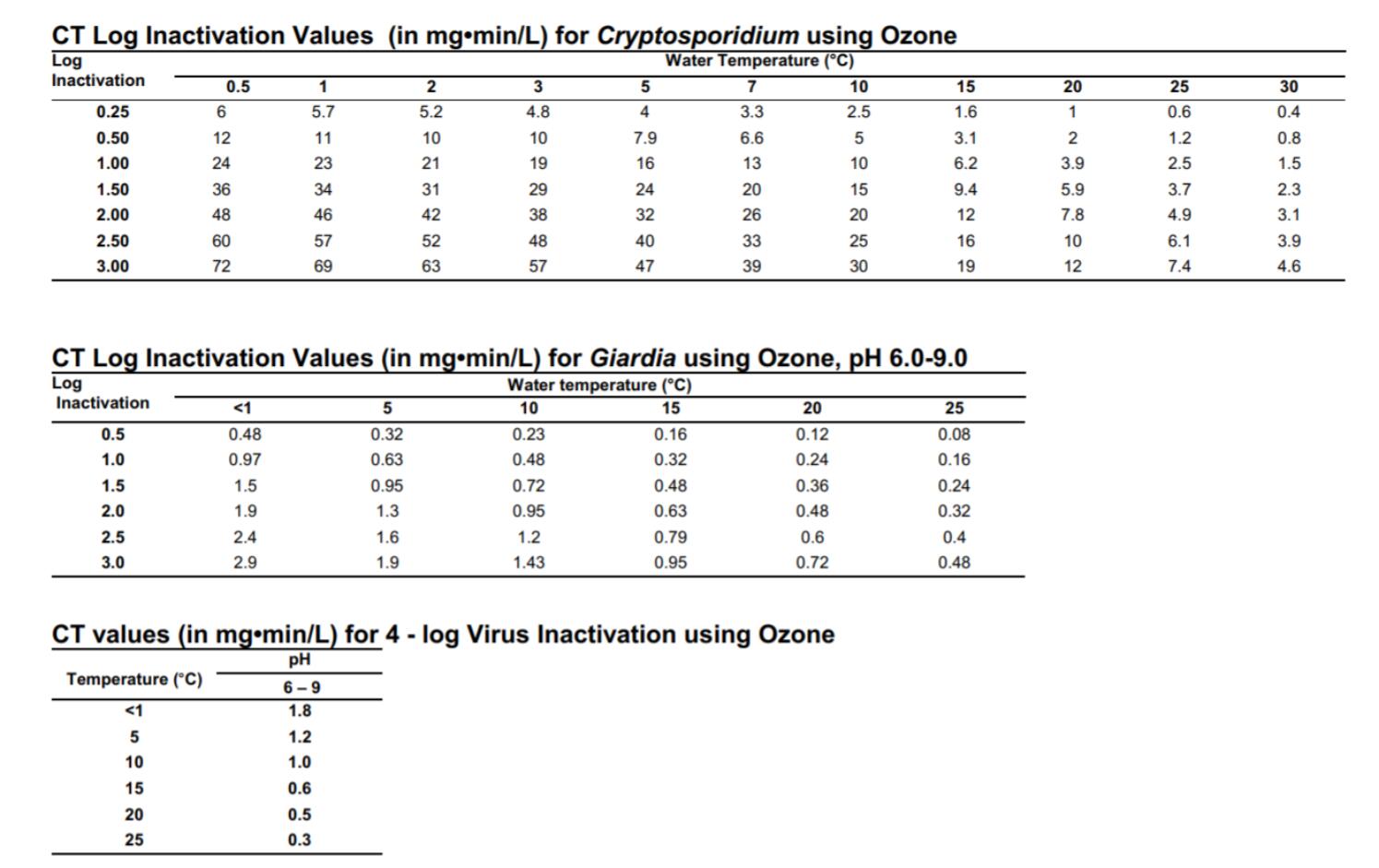
The CT disinfection value is a number that tells you when a specific type of pathogen has been "cooked" or inactivated to the desired level. These numbers come from CT value charts. For example, Chart 1 gives a set of CT values for inactivating Cryptosporidium spp. At 15 degrees Celsius, the CT value required to inactivate 99% (2 Log) Cryptosporidium spp. is 12. If my water's ozone concentration is 2 ppm, then I need to maintain the ozone level in the water for six minutes. Ozone concentration (2ppm) x time (6 minutes) = 12.
Another chart gives the CT values for using four different disinfectants to inactivate 99% of various different pathogens at 5 degrees Celsius. The CT value for Escherichia coli with ozone is very low, at 0.02. A concentration of 0.5 ppm of ozone only requires a contact time of 0.04 minutes (2.4 seconds) to inactivate 99% of Escherichia coli. Chlorine is also an oxidant, but its strength is not as great as ozone. The chart shows the CT values for three different forms of chlorine. They all have higher CT values, so for the same level of disinfection, a higher concentration or longer contact time is required.
When you start looking at Chart 1, you'll notice that water temperature has a significant impact on CT values. In cold water, ozone reacts slower than in warm water. However, remember that warmer water levels of ozone will oxidize things, so they drop faster. As ozone water moves through pipes or reaction chambers, it may start at 4 ppm and end at 2 ppm.
Temperature is not the only factor to consider. Minerals or other organic compounds in the water will be oxidized by ozone and their concentrations reduced. Contact time may also vary depending on water demand. CT value tables provide a reliable starting point, but many other factors affecting ozone and limiting its contact with specific organisms must be considered when determining how much ozone is needed. Application concentrations of ozone in water:
① The solubility of ozone in water applications ranges from 0.1mg/L to 10mg/L. Low values serve as the very low concentration required for water disinfection and purification, while high values represent the concentration achievable by "ozone water disinfectant."
② For tap water disinfection, the international standard is a dissolved ozone concentration of 0.4mg/L for four minutes, resulting in a CT value of 1.6.
③ Maintaining residual ozone concentrations between 0.1mg/L and 0.5mg/L for five to ten minutes can achieve disinfection goals in water.
④ In mineral water, an ozone solubility of 0.4mg/L to 0.5mg/L can meet sterilization quality requirements. A reasonable ozone dosage is 1.5mg/L to 2mg/L.
⑤ Bottled water treatment should achieve an ozone solubility value of 0.3mg/L to 0.5mg/L, requiring an ozone generation rate of 2g O₃ per cubic meter of water. Based on practical experience, it is easy to achieve concentrations above 8mg/L when generating ozone.


