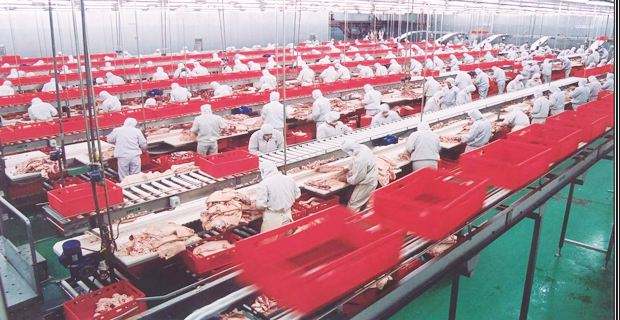
Ozone disinfection in meat processing workshops is carried out through the following steps: First, sterilization of the air, equipment, work clothes and operating tools in the workshop; second, sterilization of the processing water; and finally, disinfection of the cold storage and food preservation.
For food production workshops, microbial contamination is a very important factor affecting product quality. We all know that ozone is one of the most broad-spectrum sterilization methods, so ozone disinfection in the workshop can not only effectively kill various microorganisms but also effectively remove various odors in the workshop. Through enterprise testing, we have proven that ozone disinfection can not only make the bacterial indicators of the air, work clothes and operating tools in the workshop meet the standards but also effectively improve the odor in some meat processing workshops.
1、Sterilization of changing rooms and work clothes. Most bacteria in the workshop are brought into the workshop through the work clothes of processing personnel, which can cause large-scale spread, so this should be taken seriously. It is reported that most food processing enterprises adopt ultraviolet radiation for disinfection, but ultraviolet radiation has a natural defect that the disinfection effect is poor and cannot spread disinfection. However, ozone is a gas type of sterilization method. Ozone can diffuse in the air and can penetrate all parts of the clothing, providing good disinfection effects on the work table and ground. Therefore, ozone disinfection is undoubtedly a highly efficient and simple sterilization method.
2、Sterilization of processing water. The water contains a wide variety of bacteria, and ozone dissolves into ozone water, which has higher and faster killing rates against various bacteria, viruses, microorganisms, etc. It also removes more completely organic compounds and other polluting substances in the water. Moreover, after ozone dissolution, it will turn into oxygen, so there is no need to worry about secondary pollution. This is of great significance to food processing water.
3、Disinfection of cold storage and food preservation. The biological contamination in cold storage mainly comes from molds, which have strong resistance to chemical toxicants and can survive at low temperatures. However, experiments have proved that using ozone with a concentration of 6-120ppm for continuous disinfection for about three hours can kill highly resistant spores that have not yet germinated. After ozone sterilization, close the cold storage. It is best to carry out ozone disinfection about three days before receiving goods.
Because of its efficient and simple sterilization method, as well as its essential role in various environments that need to be disinfected, ozone has been widely used in the field of health and environmental protection, especially in food disinfection, making our lives more secure. In the future's development of health and environmental protection industry, the status of ozone will continue to rise.


