Organic wastewater from industries such as petrochemical, textile, papermaking, and pharmaceutical is typically recalcitrant and difficult to degrade. Contaminants like phenols, naphthenic acids, and polycyclic aromatic hydrocarbons are not only resistant to biodegradation but also possess biotoxicity, making them challenging to remove using conventional water treatment processes.
Ozone oxidation technology is a clean and non-secondary pollution method for treating organic wastewater. However, in practical applications, issues like poor mass transfer efficiency of ozone have been observed, leading to low utilization rates, resource consumption, and energy wastage. Microbubbles, with diameters generally less than 50um, exhibit larger surface areas, slower rising speeds, and other unique characteristics compared to conventional aeration bubbles. They have found extensive applications and research in water purification, flotation, aquaculture, and other fields. Introducing ozone microbubbles into wastewater can effectively enhance mass transfer, reduce the amount of ozone used and reaction time while degrading pollutants, thereby lowering investment and operational costs. This approach can significantly improve the efficiency of ozone oxidation.
In this study, simulated organic wastewater was prepared using phenol. The oxidation of organic matter was carried out using ozone microbubbles generated by an ozone generator and conventional bubbles produced by an aerator. The differences in bubble morphology and oxidation effects during the oxidation process were compared. Further investigations were conducted on the basis of the differences in organic degradation between the two aeration methods, focusing on ozone mass transfer and decomposition characteristics and free radical generation. Finally, theoretical analysis was performed on the relationship between bubble diameter and interface pressure using classical models, aiming to provide a reference and theoretical basis for the practical application of ozone microbubbles in organic wastewater treatment.
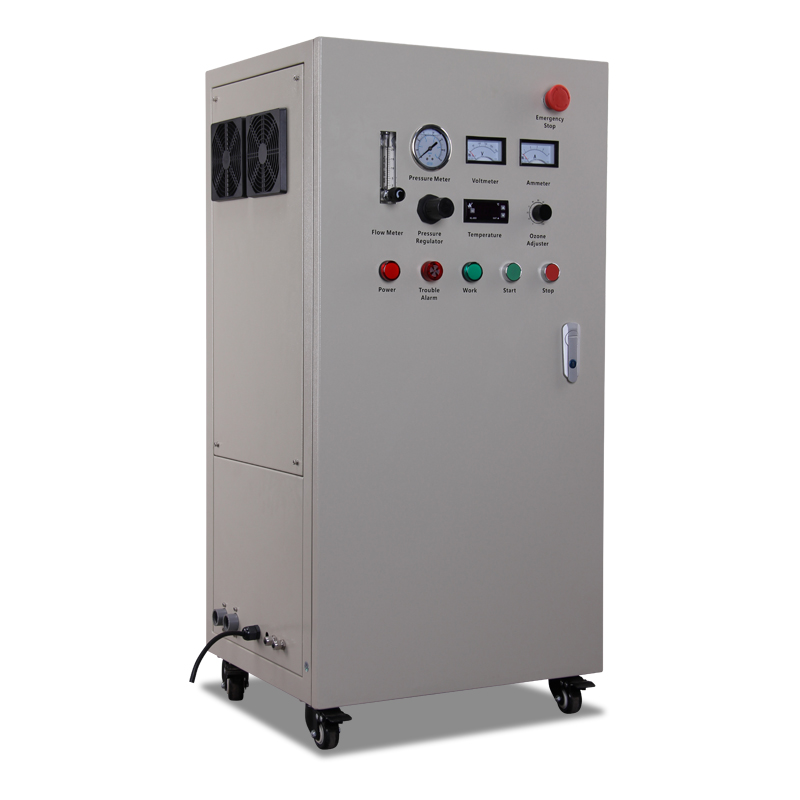
Experimental MaterialsOzone was generated using a 3S-T5 ozone generator manufactured by Beijing Tonglin, utilizing pure oxygen (99.99%) as the gas source. Phenol and tert-butyl alcohol (TBA) used for analysis were purchased from Sinopharm Chemical Reagent Co., Ltd. Deionized water was used for the experiments.
Experimental ApparatusThe experimental setup is shown in the figure below. Ozone passes through a concentration detector (3S-J5000, Beijing Tonglin) before entering the microbubble generator. The generated microbubbles are released into the bottom of the reactor, which is a closed glass container with a diameter of 10cm, height of 80cm, and an effective volume of 6L. The tail gas is passed through a desiccant (silicate) to remove moisture and eliminate its impact on subsequent ozone concentration detection. It is then discharged after passing through an ozone destroyer. During the experiment, gas flow rates were measured using gas flow meters, and flow control was achieved using gas flow control valves.
Detection MethodsDigital microscopy was used to capture images of ozone microbubbles, which were analyzed using Nano Measurer1.2 software. COD concentrations were determined using a rapid COD analyzer. Liquid-phase ozone concentrations were measured using a Palintest ozone measuring instrument. Gas-phase ozone concentrations were measured using an ozone concentration detector (3S-J5000, Beijing Tonglin). Ultraviolet-visible spectrophotometry was employed to scan the water samples for UV spectra.
ConclusionsThe microbubble size in the organic wastewater treatment process ranged from 5 to 40um, with an average diameter of 20.37um. A significant number of bubbles with diameters of 15 to 20um accounted for 38%, which was approximately 1/49.09 and 1/245.46 of the bubbles produced by an aerator with orifice sizes of 1um and 100um, respectively.
When treating organic wastewater with an initial COD concentration of 51.2mg/L using ozone microbubbles at an ozone concentration of 120mg/L and a flow rate of 75mL/min, the COD removal rate reached 89% after 40min. The oxidation reaction rate was 1.59 times faster than that obtained using an aerator with an orifice size of 1um and 3.61 times faster than that obtained using an aerator with an orifice size of 100um. The COD/O3 ratio was 0.626, and the ozone utilization rate exceeded 99.19%. After the reaction, most organic substances were oxidatively destroyed, and the total system was completely broken down into small molecular hydrocarbons and carboxylic acids.
When the ozone flow rate is 75mL/min, the mass transfer coefficient of microbubbles is 0.2065, which is 2.03 times that of a 1um bubble diffuser. Microbubbles can promote the decomposition of ozone molecules, with a decomposition coefficient of 0.0702, which is 2.83 times that of a 1um bubble diffuser. After the dissipation of microbubbles, the ozone decomposition coefficient decreases to 0.0276, which is comparable to that of conventional bubbles. The generation of free radicals is promoted by ozone microbubbles. When free radicals are shielded, the COD removal rate decreases by 77% after 40 minutes. The interfacial pressure of microbubbles used in the experiment can reach 0.5824atm, which leads to differences in properties between ozone microbubbles and larger diameter bubbles.


